.png)
Prospecter sans savoir précisément qui viser, c'est écrire à beaucoup d'entreprises pour en intéresser peu, et finir par douter de ses messages. Avant le premier envoi, il faut donc répondre à une question : comment définir son ICP en B2B ?
Définir son ICP, ou profil client idéal, consiste à décrire le type d'entreprise qui tire le plus de valeur de votre offre et qui a le plus de chances d'acheter. On le construit à partir de ses meilleurs clients, avec des critères vérifiables, puis on le teste sur une première liste avant de prospecter plus largement.
Une équipe peut avoir une idée de son client idéal sans que personne ne l'ait écrite. Chaque commercial vise alors son propre client idéal, le marketing en suit un autre, et la base de prospection mélange des comptes qui n'achèteront pas.
In this article, you'll learn:
- ce qu'est un ICP, ou profil client idéal, et ce que le sigle signifie en marketing et en vente ;
- la différence entre ICP, persona et cible ;
- pourquoi définir son ICP avant de prospecter ;
- quels critères retenir pour définir son ICP ;
- comment définir son ICP en six étapes, de vos meilleurs clients à une liste pilote ;
- à quoi ressemble une fiche ICP, avec un exemple commenté ;
- comment utiliser son ICP une fois défini ;
- comment garder son ICP à jour ;
- quelles erreurs éviter quand on définit son ICP.
L'enjeu dépasse le ciblage d'une campagne. Un ICP écrit donne à toute l'équipe la même définition du bon client, ce qui guide le choix des comptes et des messages. Vous saurez rédiger votre fiche ICP en une page, traduire vos critères d'entreprise en filtres sur les données publiques françaises, écrire vos critères d'exclusion et tester votre profil avant d'y engager votre budget.
Chez Scal-IA, la méthode de notre agence comprend un ciblage précis, fondé sur l'ICP et des données enrichies, puis des séquences LinkedIn et email connectées au CRM.
Qu'est-ce qu'un ICP (profil client idéal) ?
L'ICP, pour « ideal customer profile », est le profil client idéal d'une entreprise B2B. Il décrit un type d'entreprise : son secteur, sa taille, sa zone, sa situation et le problème que votre offre résout pour elle. C'est le profil sur lequel vous concentrez vos efforts commerciaux et marketing.
L'ICP résume les caractéristiques communes aux clients qui achètent le plus facilement, restent le plus longtemps et vous recommandent. Sans clients, il prend la forme d'une hypothèse à tester. Il ne signifie pas que vous refuserez les autres clients : il dit où concentrer la prospection active.
Le sigle a le même sens dans les deux équipes. En marketing, l'ICP sert à choisir les comptes à toucher et les messages à leur adresser ; en vente, à décider quels comptes prospecter en premier et quels leads qualifier. Hors du commerce, ICP désigne d'autres notions sans lien avec la prospection.
L'ICP fait partie des premières décisions d'une prospection B2B, juste après le choix de l'offre : il précède le fichier, le message et le choix des canaux. Notre guide de la prospection commerciale B2B replace cette étape dans l'ensemble de la démarche.
Quelle différence entre ICP, persona et cible ?
Ces trois notions sont souvent confondues, alors qu'elles répondent à trois questions différentes. La cible, ou marché cible, est l'ensemble des entreprises qui pourraient acheter. L'ICP en isole la part qui achète le mieux. La persona, ou buyer persona, décrit la personne à convaincre dans ces entreprises.
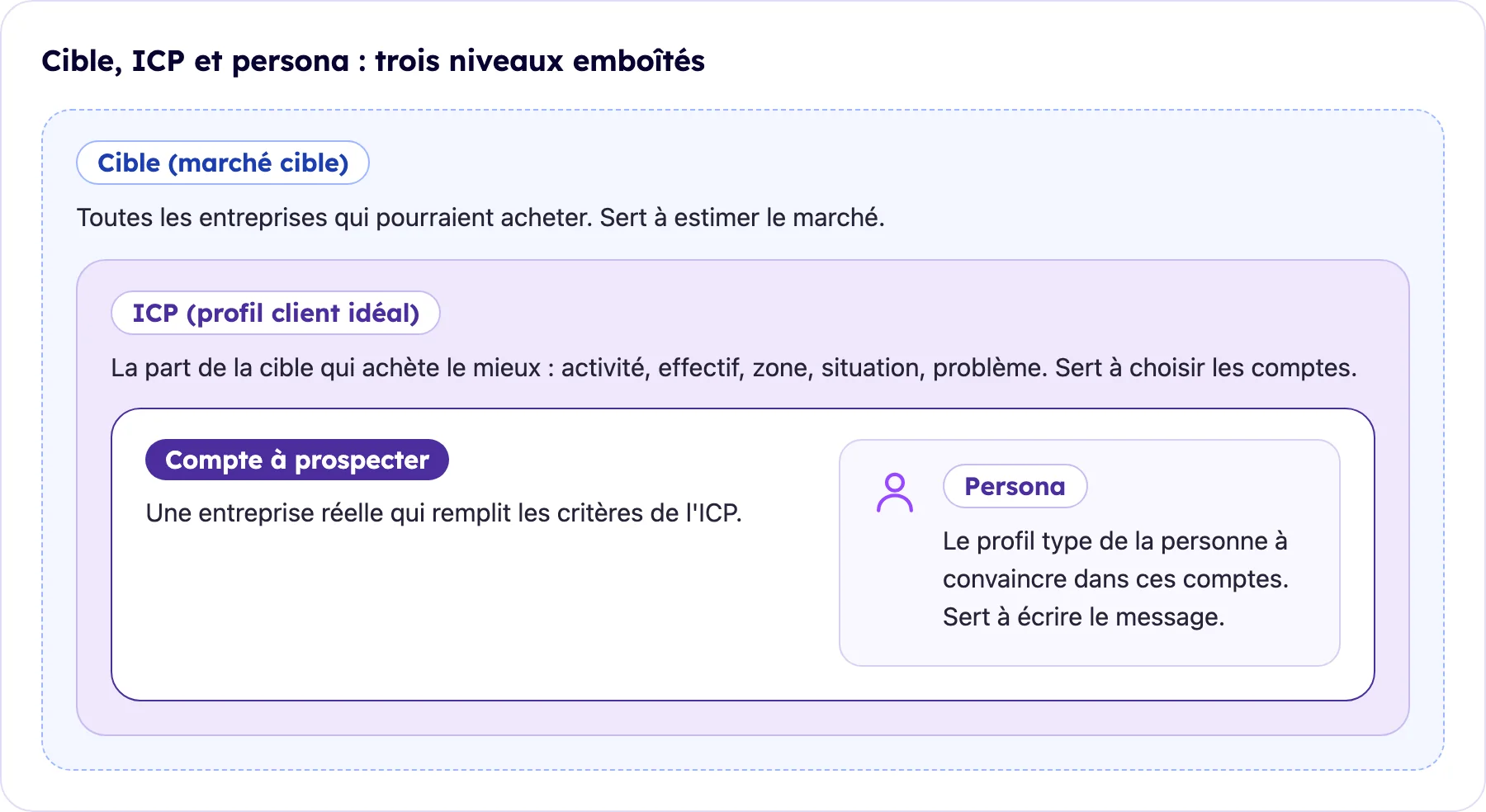
La cible contient l'ICP, la part des entreprises qui achète le mieux ; chaque compte qui remplit l'ICP est une entreprise réelle à prospecter. La persona est le profil type de la personne à convaincre dans ces comptes : on la définit après l'ICP.
En pratique, on définit d'abord l'ICP, puis quelques personas par ICP, par exemple celle qui utilise l'offre et celle qui décide. Commencer par les personas expose à écrire de bons messages à des personnes dont l'entreprise n'a pas le problème. Pour passer de l'ICP aux grands choix de marché, notre article sur la stratégie de ciblage en prospection B2B détaille les arbitrages.
Pourquoi définir son ICP avant de prospecter ?
Définir son ICP avant de prospecter évite de dépenser du temps, des messages et de la réputation sur des comptes qui n'achèteront pas. Les avantages se lisent à chaque étape de la vente.
Pourquoi l'ICP rend-il le ciblage plus précis ?
Un ICP permet d'identifier vite les prospects alignés avec votre offre. En ne gardant que les comptes qui répondent à vos critères, vous écartez dès le départ les entreprises trop petites, trop grandes ou sans le problème que vous résolvez. Vos campagnes touchent moins de comptes, mais des comptes plus proches de vos meilleurs clients.
Comment l'ICP aide-t-il à mieux employer le temps des équipes ?
Avec un ICP écrit, les équipes marketing et commerciales concentrent leur temps sur les comptes à fort potentiel. Les heures qui ne partent plus vers des comptes hors ICP servent à préparer chaque échange : recherche sur le compte, message adapté, relance au bon moment.
Pourquoi l'ICP rend-il vos messages plus pertinents ?
Un message parle mieux quand il s'adresse à un problème précis, vécu par un type d'entreprise précis. L'ICP donne ce problème et le contexte qui va avec. La conversation commerciale peut alors partir de la situation du prospect plutôt que d'une présentation générale de votre offre.
Comment l'ICP aligne-t-il marketing et ventes ?
Quand l'ICP est écrit et partagé, le marketing attire les comptes que les commerciaux veulent rencontrer. Les leads transmis répondent à la même définition, et les désaccords sur leur qualité se règlent à partir de critères écrits plutôt que d'impressions.
Quels critères retenir pour définir son ICP ?
Un bon critère d'ICP est vérifiable : vous devez pouvoir dire, pour chaque entreprise, si elle le remplit. Les critères se rangent en cinq familles, des plus faciles à obtenir aux plus difficiles.
Critères firmographiques : décrire l'entreprise
Les critères firmographiques décrivent l'entreprise elle-même : activité, taille, implantation. Pour la taille, la France dispose d'une grille officielle, fixée par un décret de 2008. Selon l'Insee, les petites et moyennes entreprises occupent moins de 250 personnes et ont un chiffre d'affaires annuel n'excédant pas 50 millions d'euros ou un total de bilan n'excédant pas 43 millions d'euros. Parmi elles, les microentreprises occupent moins de 10 personnes et ont un chiffre d'affaires annuel ou un total de bilan n'excédant pas 2 millions d'euros. Les entreprises de taille intermédiaire (ETI) n'appartiennent pas aux PME et occupent moins de 5 000 personnes, sous des plafonds de chiffre d'affaires ou de bilan.
Cette grille s'appuie sur trois données : l'effectif, le chiffre d'affaires et le total du bilan. Votre ICP peut s'y référer, puis la resserrer. Écrire « PME de 20 à 249 salariés » plutôt que « entreprises de taille moyenne » rend le critère vérifiable par toute l'équipe. La borne de 20 relève alors de votre ICP : l'Insee n'en fixe aucune à ce niveau.
Critères technographiques : décrire les outils
Les critères technographiques portent sur les outils et la maturité numérique de l'entreprise. Ils comptent quand votre offre s'intègre à un logiciel existant ou remplace une pratique manuelle. Une entreprise qui gère encore ses plannings sur tableur n'a pas le même besoin qu'une entreprise déjà équipée d'un logiciel métier.
Situation, signaux et besoin : décrire le moment
Deux entreprises identiques sur le papier n'ont pas le même intérêt pour votre offre au même moment. Un recrutement sur le poste concerné, une nouvelle implantation ou un changement de direction peuvent ouvrir une fenêtre favorable. Dans cet article, comme dans notre méthode, on appelle ces événements des signaux d'intention, au sens large. Le besoin, lui, se décrit par le problème que vous résolvez et par ce qu'il coûte au client s'il reste sans solution.
Critères d'exclusion : écrire l'anti-ICP
Un ICP complet dit aussi qui ne pas prospecter. Ces critères d'exclusion, parfois appelés anti-ICP, viennent de vos affaires perdues, de vos clients perdus et des comptes qui ont coûté plus qu'ils n'ont rapporté. Par exemple : entreprises en création si votre offre suppose une équipe déjà en place, ou groupes qui achètent par appel d'offres si vous n'y répondez pas.
Comment définir son ICP en six étapes ?
Pour définir son ICP, partez de vos clients réels, puis avancez dans un ordre qui transforme une intuition en fiche vérifiable. La durée dépend du nombre de clients à analyser et du temps qu'il faut pour obtenir des réponses à la liste pilote.
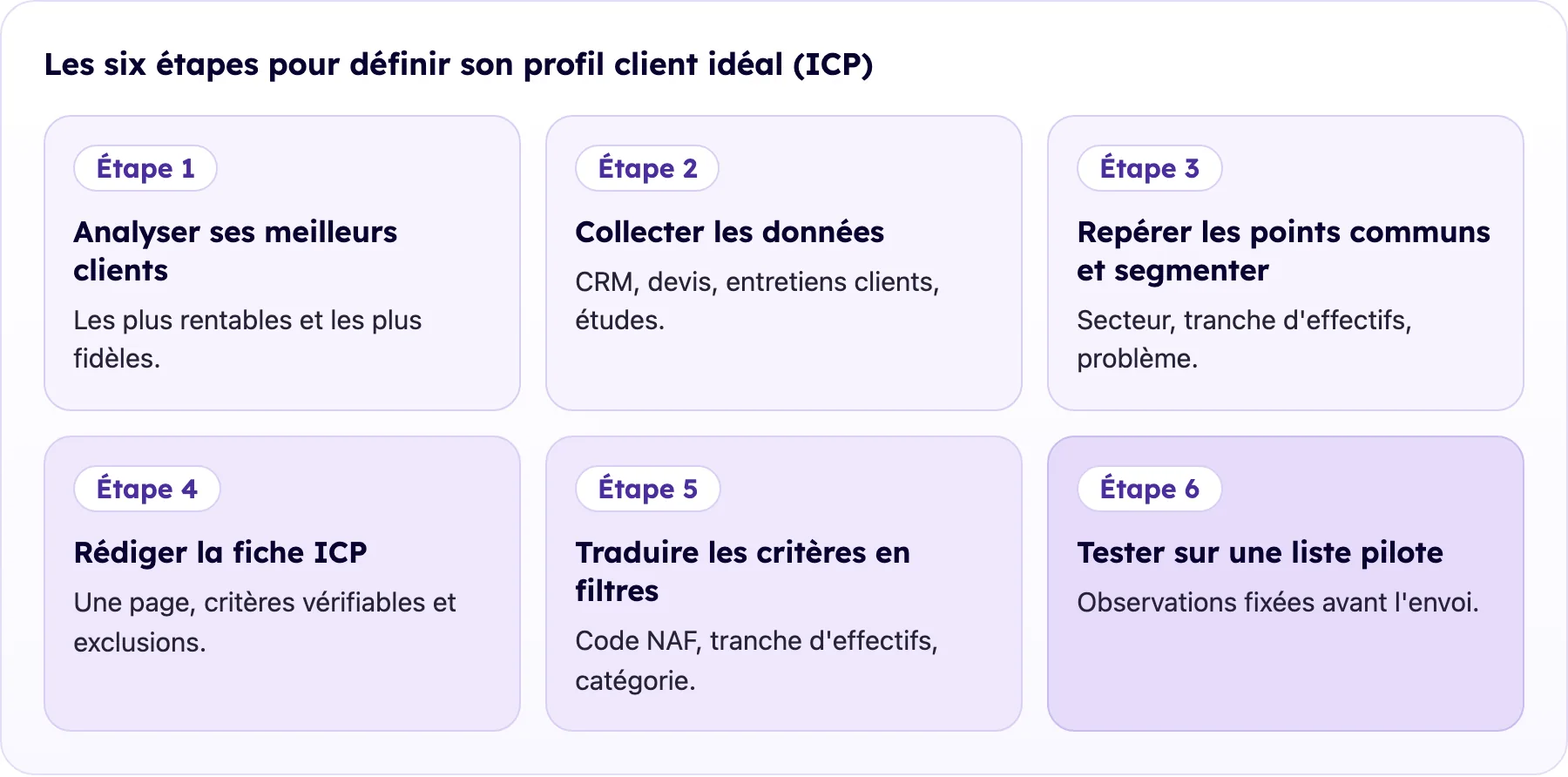
Les six étapes pour définir un profil client idéal en B2B, de l'analyse des meilleurs clients au test sur une liste pilote. Sans clients, on commence à l'étape 4 avec une hypothèse de fiche, puis on la traduit en filtres et on la teste.
Étape 1 : analyser ses meilleurs clients
Commencez par vos clients actuels, en particulier les plus rentables et les plus fidèles. Choisissez-les sur des critères de valeur : marge, durée de la relation, facilité de la vente, recommandations obtenues. Pour chacun, posez les mêmes questions. Quel est son secteur d'activité ? Quelle est sa taille, en effectif et en chiffre d'affaires ? Quel problème votre solution résout-elle pour lui, et pourquoi a-t-il acheté à ce moment-là ?
Cette analyse fait apparaître les caractéristiques communes qui définiront votre client idéal. Elle a une limite : vos clients actuels reflètent vos choix commerciaux passés, pas forcément tout le marché accessible. Regardez aussi vos affaires perdues pour compléter le portrait. Si vous débutez sans clients, écrivez une hypothèse de fiche à l'étape 4, puis passez aux étapes 5 et 6 pour la tester.
Étape 2 : collecter des données internes et externes
Appuyez-vous sur des données internes, votre CRM, vos devis et vos comptes rendus de vente, et sur des données externes, études de marché et benchmarks. Trois types de données sont utiles. Les données sur l'entreprise : secteur, taille, implantation, budget. Les données de comportement d'achat : cycle de décision, personnes impliquées, déclencheur de l'achat. Les données sur les interlocuteurs : fonction et rôle dans la décision, qui serviront à vos personas.
Complétez par quelques entretiens avec des clients. Demandez-leur ce qu'ils faisaient avant, pourquoi ils ont changé et ce qui a failli les faire renoncer.
Étape 3 : repérer les points communs et segmenter
Comparez vos meilleurs clients et cherchez ce qui revient. Une segmentation fine isole les profils qui partagent des caractéristiques avec votre client idéal : par exemple, les entreprises d'un même secteur, d'une même tranche d'effectifs, qui rencontrent le même problème opérationnel. Si deux groupes très différents ressortent, gardez deux ICP plutôt que de les fondre en un profil flou.
Étape 4 : rédiger la fiche ICP
Une fois les segments identifiés, rédigez la fiche de votre client idéal. Elle reprend les rubriques de l'exemple présenté plus bas : une phrase de synthèse, l'activité, la taille, la zone, la situation de l'entreprise, le signal d'intention, le problème résolu, les critères d'exclusion et, en renvoi, la persona associée. Pour chaque rubrique, notez comment la vérifier. La fiche tient sur une page.
Étape 5 : traduire les critères en filtres de recherche
Un critère que personne ne peut filtrer reste théorique. Les critères d'entreprise se filtrent dans la base Sirene, diffusée sur data.gouv.fr : activité principale (code NAF), tranche d'effectifs et catégorie d'entreprise. La même page signale la fonction « Constituer une liste » de l'Annuaire des Entreprises. Les autres critères, outils, signaux et problème, se vérifient compte par compte, sur le site de l'entreprise, dans ses offres d'emploi ou en échangeant avec elle.
Concrètement, une activité comme « maintenance et installation technique » se traduit en codes de la nomenclature de l'Insee, par exemple 33.12Z, Réparation de machines et équipements mécaniques, ou 43.22B, Travaux d'installation d'équipements thermiques et de climatisation. Trois précisions de la page de la base Sirene, relevées le 17 octobre 2026, changent la façon de filtrer. Les tranches d'effectifs y sont mises à jour avec les valeurs au 31/12/2024 : vérifiez l'effectif réel des comptes retenus. La catégorie d'entreprise n'est renseignée que lorsqu'elle est connue. Enfin, le code NAF change de nomenclature à compter du 1er janvier 2027, et le nouveau code est déjà diffusé à titre informatif dans les fichiers : notez l'ancien et le nouveau code de chaque activité retenue.
La même page rappelle une précaution. La base Sirene contient des données à caractère personnel, et il est de votre responsabilité de tenir compte du statut de diffusion le plus récent de chaque personne physique. Les unités marquées « P » ont fait l'objet d'une opposition et ne sont diffusées que partiellement.
Étape 6 : tester son ICP sur une liste pilote
L'ICP n'est pas figé. Avant de l'appliquer à toute votre prospection, testez-le sur une liste pilote de quelques dizaines de comptes. Fixez avant l'envoi ce que vous observerez : nombre de réponses, rendez-vous obtenus, part des comptes qui confirment le problème. Sur un si petit nombre, ces résultats restent une simple indication : quelques réponses de plus ou de moins les font varier fortement. Lisez aussi le contenu des réponses, élargissez le test si le résultat reste ambigu, puis ajustez la fiche.
À quoi ressemble une fiche ICP ? Exemple commenté
Voici une fiche ICP complète, construite pour cet article autour d'un éditeur fictif de logiciel de gestion des interventions pour les entreprises de maintenance. Les critères sont plausibles mais inventés : l'intérêt est la forme, critère par critère, avec le moyen de vérifier chacun.
La phrase de synthèse se retient sans relire le tableau. Chaque ligne indique où vérifier l'information, ce qui permet de constituer la liste sans réinterpréter les critères. Les exclusions sont écrites, ce qui évite de relancer chaque trimestre les mêmes comptes qui ne peuvent pas acheter. La persona n'est qu'un renvoi : elle a sa propre fiche.
Comment utiliser son ICP une fois défini ?
Une fiche ICP n'a de valeur que si elle change la façon de prospecter. Elle sert à trois moments : constituer la liste, écrire les messages et trier les leads.
Constituer la liste de comptes à prospecter
Partez de la base Sirene et appliquez les filtres d'entreprise de l'étape 5 : code NAF, tranche d'effectifs et catégorie d'entreprise. Vérifiez ensuite compte par compte la situation et les signaux, sur le site de l'entreprise et dans ses offres d'emploi, puis retirez les comptes qui tombent sous un critère d'exclusion.
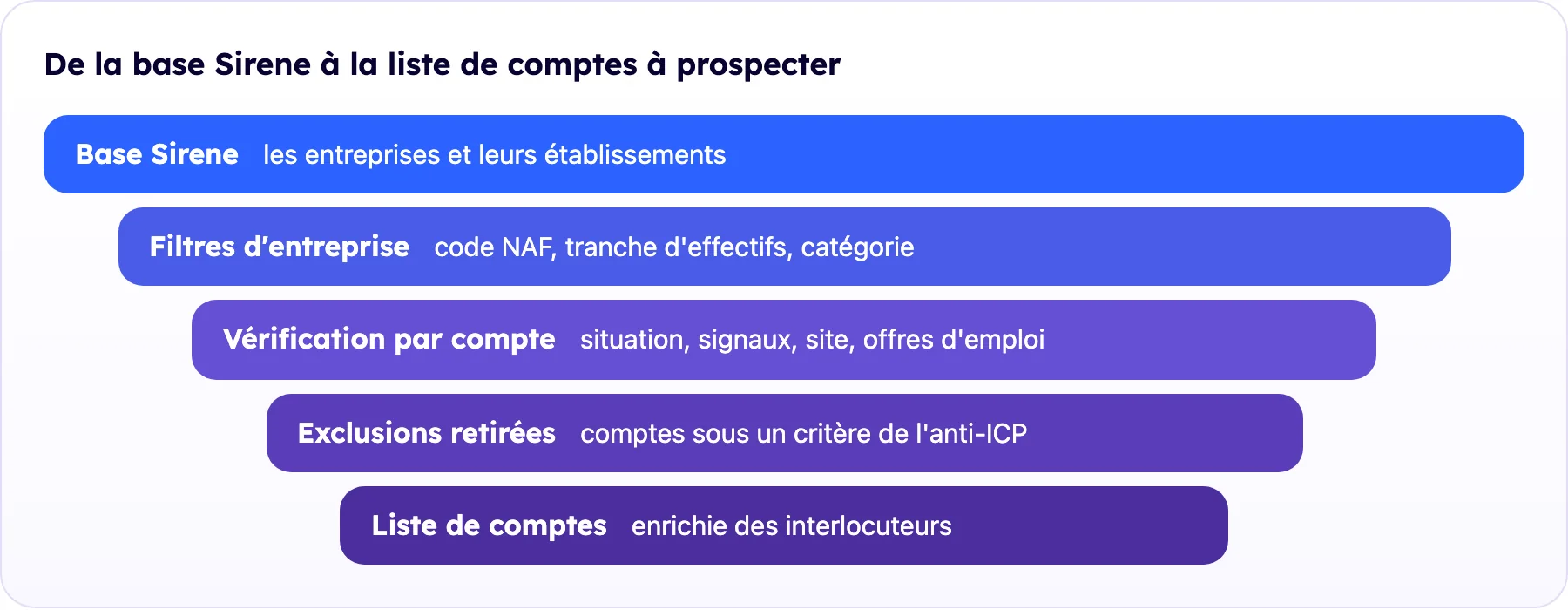
Chaque étage de l'entonnoir retire des entreprises : les filtres d'entreprise s'appliquent dans la base Sirene, la situation et les signaux se vérifient compte par compte, puis les exclusions sortent les comptes qui ne peuvent pas acheter. La largeur des étages illustre l'ordre, pas un volume mesuré ; les tranches d'effectifs de Sirene sont datées, vérifiez l'effectif réel des comptes retenus.
Complétez enfin chaque compte avec les bons interlocuteurs : notre article sur l'enrichissement de données B2B détaille les sources de contacts fiables. Pour organiser cette base dans la durée, voyez notre article sur l'ICP, le ciblage et la base de prospection.
Écrire des messages pour chaque persona
Le problème inscrit dans la fiche ICP devient l'angle du premier message. Adaptez ensuite la formulation à chaque persona : le responsable d'exploitation parlera des plannings et des comptes rendus, le dirigeant de la facturation et du temps perdu. Le canal suit la persona : celle qui vit sur le terrain se joint plus souvent par téléphone que par un long email.
Trier et prioriser les leads
L'ICP sert aussi de grille de tri. Notre grille de travail croise deux questions : le lead remplit-il la plupart des critères de la fiche, et montre-t-il un signal d'intention ? Elle donne une action par case : contacter, suivre, qualifier ou laisser de côté. Un lead qui tombe sous un critère d'exclusion sort du circuit.

Grille de travail Scal-IA pour choisir l'action sur un lead selon deux questions : remplit-il la plupart des critères de la fiche ICP, et montre-t-il un signal d'intention ? Un lead qui tombe sous un critère d'exclusion sort du circuit, quelle que soit sa case.
Pour attribuer des points selon la ressemblance avec l'ICP et les signaux observés, notre article sur le scoring de leads avec l'IA décrit la méthode.
Comment garder son ICP à jour ?
Un ICP vieillit avec votre offre et votre marché. Les bonnes pratiques suivantes le gardent pertinent sans le réécrire à chaque campagne.
Quand faut-il réviser son ICP ?
Les marchés et les besoins des clients évoluent. Planifiez une revue régulière, à un rythme adapté à la durée de votre cycle de vente. Ajoutez une revue exceptionnelle quand un événement le justifie : nouvelle offre, changement de prix, nouveau marché ou série d'affaires perdues sur le même motif. Une conjoncture difficile en est un autre : notre article sur la prospection B2B en période de crise traite ce cas. Notez chaque version de la fiche et la raison du changement.
Pourquoi impliquer les équipes commerciales et marketing ?
Les personnes en contact direct avec les prospects voient ce que les tableaux ne montrent pas : objections récurrentes, nouveaux déclencheurs d'achat, comptes qui ressemblent à l'ICP sans jamais acheter. Les faire participer à la revue enrichit l'ICP d'informations concrètes et récentes, et le rend plus facile à appliquer.
Quels outils utiliser pour faire vivre son ICP ?
Le CRM est l'outil central : il permet de marquer chaque compte selon sa ressemblance avec l'ICP et de comparer ensuite les taux de conversion des comptes qui le respectent et des autres. Les plateformes d'intelligence commerciale, comme LinkedIn Sales Navigator ou HubSpot, aident à trouver les comptes qui correspondent et à suivre leurs signaux.
Quelles erreurs éviter quand on définit son ICP ?
Quatre erreurs rendent un ICP difficile à appliquer.
Erreur 1 : décrire tout le marché
Un ICP qui inclut toutes les tailles, tous les secteurs et toute la France décrit la cible tout entière. S'il ne vous fait écarter aucun compte, il est trop large. Resserrez-le jusqu'à ce qu'il exclue une part visible des entreprises que vous auriez contactées sans lui.
Erreur 2 : confondre ICP et persona
Décrire « un directeur commercial pressé, très actif sur LinkedIn » revient à écrire une persona. L'ICP décrit l'entreprise ; la persona décrit la personne. Sans ICP, vous risquez de convaincre un bon interlocuteur dans une entreprise qui n'a pas le problème.
Erreur 3 : choisir des critères impossibles à vérifier
« Entreprises innovantes » ou « clients exigeants » ne se filtrent dans aucune base. Chaque critère doit se vérifier dans une source : registre, site de l'entreprise, offre d'emploi, échange avec le prospect. Un critère invérifiable produit une liste que chaque commercial interprète à sa façon.
Erreur 4 : écrire l'ICP une fois pour toutes
Un ICP rédigé au lancement et jamais relu finit par décrire les clients d'une autre époque. Testez-le, mesurez ce que donnent les comptes qui le respectent, et révisez-le selon un calendrier connu de toute l'équipe.
Conclusion : comment définir son ICP en B2B ?
Pour définir son ICP en B2B, partez de vos meilleurs clients réels plutôt que d'un portrait imaginé. Repérez ce qu'ils ont en commun, écrivez une fiche d'une page avec des critères vérifiables et des exclusions, puis testez-la sur une liste pilote avant de l'étendre.
Quatre critères disent si votre ICP est prêt. Il écarte des comptes que vous auriez contactés sans lui. Chaque critère se vérifie dans une source. L'équipe commerciale et l'équipe marketing l'appliquent de la même façon. Enfin, il a été testé sur une liste pilote. Révisez-le ensuite à date fixe et chaque fois que votre offre change.
Chez Scal-IA, le ciblage fondé sur l'ICP fait partie de notre méthode de prospection, avant le choix des comptes, des messages et des séquences.
Questions fréquentes sur l'ICP
Que signifie ICP en marketing ?
En marketing, ICP signifie « ideal customer profile », soit profil client idéal. C'est la description du type d'entreprise qui tire le plus de valeur d'une offre et qui a le plus de chances d'acheter. Le marketing s'en sert pour choisir les comptes à toucher et les messages à leur adresser.
Que veut dire ICP en commercial ?
En commercial, l'ICP est le profil d'entreprise que les vendeurs prospectent en priorité. Il sert à constituer la liste de comptes, à qualifier les leads entrants et à décider où passer son temps. Un lead qui correspond à l'ICP et montre un signal est traité en premier ; sans signal, il est suivi de près ; un lead qui s'en éloigne est qualifié plus finement avant tout effort.
Combien d'ICP faut-il définir ?
Commencez par un seul ICP, celui de vos meilleurs clients, et prospectez-le jusqu'à bien le connaître. Ajoutez un deuxième ICP seulement si l'analyse de vos clients fait apparaître un groupe très différent, avec un autre problème ou un autre circuit de décision.
Comment définir son ICP sans avoir de clients ?
Sans clients, écrivez une hypothèse d'ICP à partir du problème que votre offre résout et des entreprises qui le vivent le plus. Rédigez la fiche, traduisez-la en filtres, puis testez-la sur une liste pilote en fixant à l'avance ce que vous observerez. Le pilote donne un premier signal, sans valeur de preuve. Il ne remplace pas l'analyse de clients, que vous ferez dès les premières signatures.
Comment Scal-IA utilise-t-elle l'ICP en prospection B2B ?
L'agence Scal-IA met en place une prospection B2B automatisée et personnalisée dont la méthode comprend un ciblage précis, fondé sur l'ICP et des données enrichies, puis des séquences multicanales sur LinkedIn et par email, connectées au CRM.