.png)
Three acronyms appear frequently in many B2B sales guides: SONCAS, SPIN, and BANT. Many present them as rivals, even though each addresses a different question. Which sales method should you choose—SONCAS, SPIN, or BANT—in B2B?
None of the three replaces the others. BANT is used to decide whether to pursue a prospect; SPIN is used to uncover the prospect’s real problem through questions; and SONCAS is used to choose the argument that matches the prospect’s motivation. The right choice depends on the task at hand: qualifying, discovering, or making a case.
The pitfall lies in choosing a method the way you would choose a tool, and then applying it from start to finish. Going through an entire SPIN questionnaire during a cold call is likely to annoy the listener. Presenting a SONCAS argument before any qualification has been established may be directed at someone who will never buy. Every method has its own scope of application, and the key is to understand it.
In this article, you'll learn exactly:
- what each method—SONCAS, SPIN, or BANT—does, and when it is applied;
- how to use the SONCAS method with a B2B buyer;
- how to ask SPIN questions without making a short conversation feel too heavy;
- whether BANT is sufficient to qualify a B2B prospect;
- Which method to choose depending on the problem to be solved;
- How to string together SONCAS, SPIN, and BANT in a single rally.
The key is knowing which method to use at what point, rather than piling them all on top of each other. You’ll leave with a chart that matches each method to the problem it solves, phrasing tailored to a B2B buyer, and a complete conversation presented as a teaching example. You’ll also know where each method ends, so you don’t ask it to do what it isn’t designed to do.
At Scal-IA, we start by defining the target audience and the message, relying on a team rather than a tool. Our team implements an automated, personalized, and measurable lead generation system, from intent detection to multichannel automation.
What does each method do: SONCAS, SPIN, or BANT?
A sales method is a framework of questions or arguments that structures a specific stage of the interaction with a prospect. Based on our analysis, none of the three methods alone covers the entire cycle, which makes them complementary. Our article on the progression from qualification to closing places these stages within the overall sales cycle.
The SONCAS method is a framework for analyzing purchasing motivations. Its name is an acronym for Safety, Pride, Novelty, Comfort, Money, and Sympathy, sometimes supplemented by a seventh letter—Environment—which forms SONCASE. Pipedrive, a secondary source, attributes it to Jean-Denis Larradet in 1993. It is used to choose the argument that will resonate with the prospect, not to decide whether it is worth speaking with them.
SPIN selling is a questioning framework. Its name refers to four types of questions: Situation, Problem, Implication, and Need-payoff—that is, the value of the solution. It emerged from field research: Neil Rackham and his team analyzed more than 35, 000 sales calls made by 10,000 salespeople in 23 countries over a 12-year period. The book’s publisher presents it as a comprehensive guide to the entire sales process. We view it as a discovery tool, since its questions are primarily designed to understand the prospect’s problem: this is Scal-IA’s interpretation, not the publisher’s.
BANT is a four-criteria qualification framework: Budget, Authority, Need, and Timing. For HubSpot, it’s a technique used to determine whether a prospect is ready to buy. It answers a single question: Should we continue pursuing this prospect?
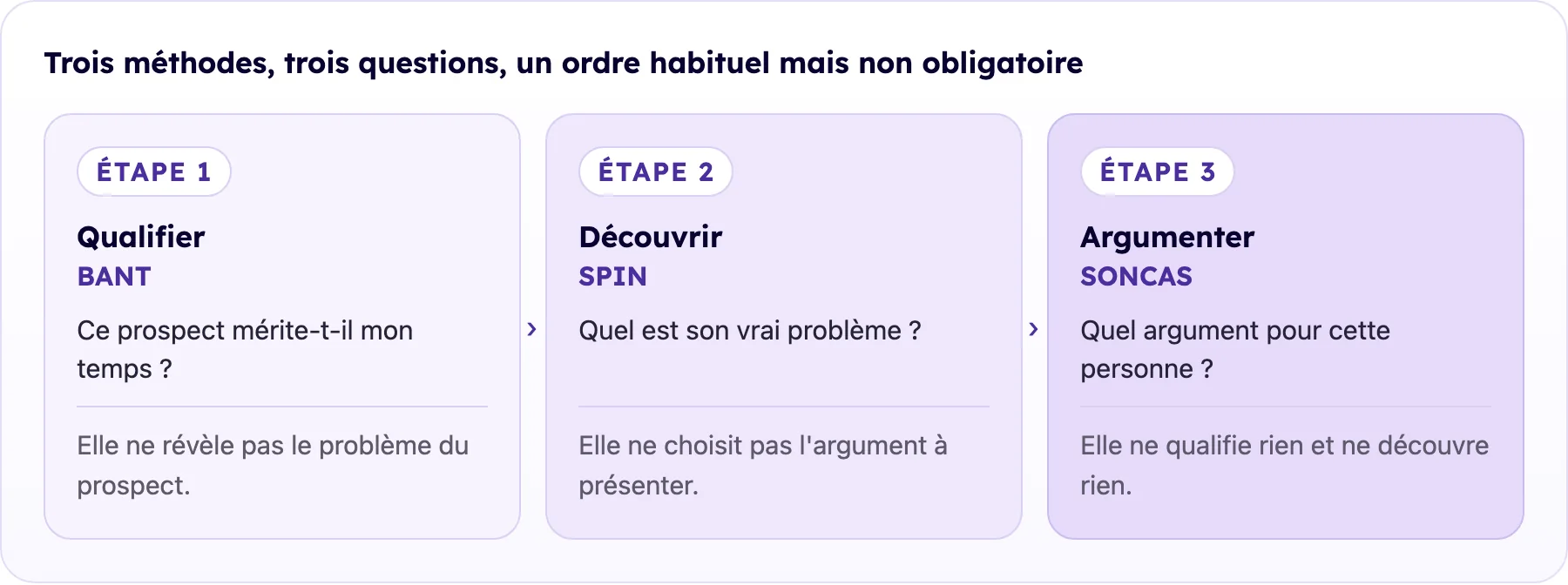
The three methods applied to a typical business transaction, along with what each one addresses and what it does not. The order is a convention: in prospecting, we often go back and forth, as shown in the example in the last section.
How do you use the SONCAS method with a B2B buyer?
The principle can be summed up in one sentence: every person you’re speaking with has a primary motivation, and your argument must address that motivation. But you still need to know how to identify it, structure your argument, and understand the limitations of this method.
What are the seven levers of SONCAS (SONCASE)?
The table links each selling point to what the buyer is looking for, a signal to watch for in their words, and a way to frame your argument. The signals and phrasing are examples provided by Scal-IA; use them only if they apply to your offer.
In B2B, every factor translates into a risk or a business challenge. Security, for example, can involve the risk of losing money, time, or even a job. A buyer who mentions security may be thinking about what’s at stake for them within their own company.
How can you identify a buyer's primary motivator?
You identify a leverage point by listening rather than relying on intuition. If you’re unsure, ask an open-ended question, such as “What would matter most to you in making this decision?” or “What concerns would you have about a change?”, and let the person respond. In a company, several people influence a purchase decision, and each may have a different leverage point: the executive might mention money, while the user might mention convenience. Each person, therefore, uses their own argument.
CAP or CAB: What structure should the argument follow?
SONCAS is combined with a sales pitch structure. CAP, which stands for Features, Advantages, and Proofs, presents evidence of the advantages; CAB, which stands for Features, Advantages, and Benefits, highlights the benefits provided by the product or service, according to Pipedrive. Our take: CAP is appropriate when the buyer is hesitant, and CAB when the buyer needs to envision the future. Our article on the sales pitch in under 60 seconds shows how to condense the sales pitch.
How do you apply the SONCAS method in four steps?
Based on our experience, it takes just four steps to implement SONCAS in B2B:
1. Identify: From the very first exchanges, note the words that indicate a leverage point: risk, timeline, cost, image, novelty.
2. Prioritize: Choose one primary lever and, if necessary, a second one, without stacking them.
3. Choose the structure: CAP if the buyer is unsure, CAB if the buyer needs to plan for the future.
4. Check: Restate what you’ve understood—for example, “If I understand correctly, the most important thing for you is the cost”—and then adjust your statement if the person corrects you.
Here is an instructional example for the “Money” lever. A buyer asks how much to budget for the purchase. The sales representative responds using the CAP method: “The software replaces two current subscriptions (feature), which reduces your fixed costs (benefit). I’ll calculate the difference based on your own volumes (proof).”
What are the limitations of the SONCAS method?
SONCAS has two limitations. It says nothing about actual need or purchasing power: a well-identified trigger does not make a prospect qualified. And pride must never turn into flattery, which many buyers can spot. Common mistakes stem from this: assigning a trigger based on the person’s job title, piling multiple triggers into a single message, or making a sales pitch before listening.
How can you ask SPIN questions without making a short conversation feel too heavy?
To keep a short conversation light, prepare the "Situation" questions in advance and ask only one "Problem" question, one "Implication" question, and one "Need-Payoff" question during the conversation.
The Four Types of SPIN Questions, with an Example
SPIN questions move from context to value. The table provides an example for each type, based on the fictional case from the previous section: a sales representative speaking with an operations manager at a small transportation company.
The "Situation" question is only asked during the oral exam if the preliminary research did not provide the answer.
How can I make SPIN more concise for a cold call or a message?
A full questionnaire is still too much to ask for in a cold call or a LinkedIn message. This approach stems from a large-scale study that concluded that methods designed for small sales do not apply to large sales.
Our take: The less at stake and the shorter the decision-making process, the more concise the questionnaire should be.
There are two rules that can help with this:
- Prepare situational questions before the meeting by researching the company and the individual. Huthwaite also notes that, when dealing with a prospect who is already comparing suppliers, overly obvious situational questions are redundant.
- Ask one "Problem" question, one "Implication" question, and one "Need-Payoff" question, then let the prospect answer without filling the silence.
Is BANT sufficient to qualify a B2B prospect?
No: BANT is used for sorting; it doesn't help you understand. The four criteria boil down to four questions, which HubSpot formulates as follows:
- Budget: Does the prospect have the ability—and the intention—to spend enough on the product or service?
- Decision-maker: Is this the person who will have the final say on the purchase decision?
- Need: Does the product or service effectively solve the customer's problem?
- Timing: Will they need the product or service soon?
Three limitations, which stem from our interpretation rather than from any measurement:
- Authority, when applied as a simple “yes” or “no,” assumes a single decision-maker. HubSpot notes that the prospect may need to go through an approval process, and in many B2B purchases, multiple people validate the choice. It’s better to map out who is involved than to simply check “decision-maker: yes or no.”
- A budget isn't always in place before the need arises. A prospect who hasn't set aside any funds may allocate a budget once the problem has been assessed—which is precisely what the SPIN method does.
- Asking four closed-ended questions in a row can come across as an interrogation. Instead, save them for the end of the exploratory phase, when the conversation calls for them.
HubSpot itself offers an expanded model called GPCT / BA / C&I, which adds the prospect’s objectives and action plan to the BANT criteria. BANT remains useful for quickly narrowing down a list of prospects, especially before scheduling a meeting. Our article on techniques for effectively qualifying leads provides details on the qualification process, its criteria, and the questions to ask.
Which method should you choose based on the problem at hand?
Start with the question that’s stumping you, rather than the acronym. The chart matches each question with a method, the appropriate time to use it, what it doesn’t do, and the first step to take. It also includes two more involved methods for situations where the first three are no longer sufficient.
What do the sources say about MEDDIC and the Challenger Sale?
They describe MEDDIC (Metrics, Economic Buyer, Decision Criteria, Decision Process, Identify Pain, Champion) as a more in-depth approach for long sales cycles and high-value transactions. They present the Challenger Sale—outlined in the book by Matthew Dixon and Brent Adamson—as a way to support and guide a prospect, gently leading them toward a decision. The rest of the table reflects our interpretation: among the sources we reviewed, no primary source measures the comparative effectiveness of these methods. Some guides quantify their impact; we have not included any of them here.
Should you base your decision on the length of the sales cycle?
Competing guides tend to focus on the length of the sales cycle. Claap notes that the BANT framework may seem too superficial for complex B2B sales, and that the SPIN framework takes longer than BANT, which isn’t suitable for fast-paced cycles. The two approaches complement each other: the length of the cycle tells you how much time you have, while the problem to be solved tells you what to do with that time.
Three Rules for Applying the Grid
Three rules follow from this grid:
- Before the initial contact, none of these methods are effective: they don't identify the prospect or initiate the conversation. It's the targeting and identification of signals of intent that do the job.
- As soon as the prospect responds, understanding their needs takes precedence over making a sales pitch. Making a sales pitch before you understand the problem leads to promoting an offer that the prospect may not have been looking for.
- The more collective the decision, the more important it is to identify the decision-makers; the shorter the discussion, the more important it is to limit yourself to one question and one lever.
How do you combine SONCAS, SPIN, and BANT in a single conversation?
The methods are applied sequentially based on the prospect's responses rather than in a fixed order. Here is an illustrative example using a fictional company, followed by how it can be adapted to a written message.
A step-by-step exploration
This table tracks a call from start to finish. Camille sells route-planning software. She calls Marc, the operations manager of a small-to-medium-sized road transport company that she identified because it is hiring drivers.
The order varied: elements of BANT were introduced during the preparation phase and then at the end of the exchange (Authority and Timing), and the leverage point was identified during the questions—it had not been anticipated beforehand. Camille did not address the Budget: she will return to it in the next exchange. This example illustrates a sequence of events; it does not prove the effectiveness of any particular method, and a real exchange would include objections that are not shown here.
How can you adapt these methods for use in an email or on LinkedIn?
In a written message, email, or LinkedIn post, we recommend asking just one question—a “Problem” type question—based on a public signal. A “lever” should only be added if the signal justifies it, and it remains a hypothesis. For example: “Marc, your company is hiring drivers: how does this change your route planning?” ” No leverage is suggested here: the hiring itself warrants a question but says nothing about the motivation. The leverage will come from the response. Before writing to a specific person, check the rules applicable to B2B prospecting. If Marc raises an objection, our article on handling B2B objections takes over. For the final decision, our article on B2B sales closing details the next steps.
Conclusion: Which Method Should You Choose—SONCAS, SPIN, or BANT?
Not one against the other: whichever one answers the question at hand. BANT when you need to decide if a prospect is worth your time, SPIN when you need to understand their problem, SONCAS when you need to choose the right argument for the person you’re talking to. If you have to learn just one at first, choose the one that addresses your current challenge. Meetings that go nowhere call for BANT; prospects who say “interesting” and then disappear call for SPIN; arguments that fall flat call for SONCAS. This combination is our take on it.
Three criteria guide the choice: the issue you’re struggling with, the duration of the discussion, and the number of decision-makers. No method can replace advance preparation or a discussion tailored to the individual.
At Scal-IA, we start with targeting and messaging, because no sales approach can make up for a poorly chosen list. Our agency handles the strategy, the technical aspects, and the ongoing optimization of your lead generation efforts.
Frequently Asked Questions About the SONCAS, SPIN, and BANT Methods
What is the difference between SONCAS and SPIN?
SONCAS identifies the buyer's motivation to determine which sales pitch to present. SPIN uses questions to bring the buyer's problem to light. The former is used to make a sales pitch, while the latter precedes the sales pitch.
Is the SONCAS method suitable for B2B?
Yes, provided that each selling point is framed as a business issue: safety becomes a risk for the buyer within their company, money becomes a cost that must be justified, and time saved translates into convenience for their team. It does not qualify the prospect on its own and must be combined with a discovery or qualification method.
What does BANT mean in sales?
BANT stands for four qualification criteria: Budget, Authority, Need, and Timing. It is used to quickly determine whether a prospect is worth investing more time in, without replacing a thorough assessment of their problem.
Can SPIN be used in a prospecting email?
Partly. In an email, we recommend asking just one question—preferably a “Problem” question—and including a call to action only if a public signal warrants it. “Implication” and “Need-Payoff” questions are best asked verbally, when the prospect responds.
MEDDIC or BANT: Which One Should You Choose?
The BANT framework, which qualifies a prospect based on Budget, Authority, Need, and Timing, allows for quick screening and is suitable for an initial interaction. MEDDIC (Metrics, Economic Buyer, Decision Criteria, Decision Process, Identify Pain, Champion) is a more in-depth approach, suited for long sales cycles and high-value transactions involving multiple decision-makers.
What does Scal-IA offer in terms of B2B lead generation?
Scal-IA offers automated B2B lead generation, from intent detection to multichannel automation.