.png)
To sell to other companies on a regular basis, you need to reach out to them rather than wait for them to come to you. But you still need to know where to start, who to contact, and what steps to take. What is B2B sales prospecting, and how do you do it?
B2B sales prospecting encompasses the activities used to identify companies likely to make a purchase, contact the right person at those companies, and secure a qualified appointment before the sales team takes over. It follows a specific process: defining the target audience and prospect list, preparing the message, making contact, qualifying leads, following up, and then handing off the appointment.
A team that only engages in prospecting when its order book is running low often sends out emails to a poorly targeted list, gives up after a few unanswered messages, and concludes that prospecting doesn’t work in its industry. In this case, the problem lies much more with the method than with the principle itself.
In this article, you'll learn:
- what B2B sales prospecting is, and what distinguishes a prospect from a lead;
- the difference between B2B and B2C lead generation;
- Why engage in B2B sales prospecting;
- What are the different types of sales prospecting?;
- Which B2B lead generation channels to choose based on your situation;
- how to build a reliable B2B prospecting database;
- What are the steps involved in B2B sales prospecting?;
- How to organize a one-month B2B lead generation campaign;
- What CNIL rules must be followed when conducting marketing activities in France;
- What tools to use for B2B sales prospecting;
- What metrics should you track to measure your lead generation efforts?;
- What mistakes cause a sales prospecting effort to fail?
The challenge is to move from a reactive approach to a proactive one when it comes to lead generation. You’ll learn how to define your target audience, build a contact list using public data, choose your channels, follow each step in sequence without skipping any, and interpret the right metrics. You’ll also leave with a sample campaign schedule, a sample email with commentary, and the guidelines governing email and phone outreach to professionals in France.
At Scal-IA, our agency implements B2B lead generation systems, ranging from intent detection to multichannel sequences integrated with CRM.
What is B2B sales prospecting?
Sales prospecting refers to all the actions taken by a company to find new customers. In B2B—which stands for “business-to-business”—these customers are other companies, organizations, or government agencies. Therefore, the focus is on a person who makes purchases on behalf of their organization, rather than on a consumer.
This stage occurs at the very beginning of the sales cycle. The sales representative identifies accounts, contacts the right person, and verifies that a need exists. The goal is to secure a qualified appointment. The actual sales process—the proposal and then the negotiation—begins afterward.
Suspect, prospect, lead: What's the difference?
These terms refer to different levels of the relationship, and confusing them can lead to inaccurate tracking. Here are the definitions used in this article:
- A lead is a company that meets your criteria on paper but with which you have no contact;
- A prospect is a potential customer whom you are contacting or will contact; they may be a "cold" prospect, if they don't know you, or a "warm" prospect, if they already have a connection with you;
- A lead is a contact who has shown some indication of interest: a response, a download, or a request;
- A qualified lead has a genuine need, an identified point of contact, and a reason to move forward: this is the lead that secures the appointment;
- A customer signed.
Lead generation takes a company from being a "suspect" to a "qualified lead." The sales process does the rest.
Prospecting and Lead Generation: Where Is the Line?
Lead generation attracts potential customers to you through content, advertising, or search engine optimization. Prospecting targets accounts that have been selected in advance. The two complement each other: an inbound lead must also be qualified, and active prospecting benefits from a website that puts prospects at ease when they search for you.
What is the difference between B2B and B2C lead generation?
B2B sales outreach is aimed at organizations where decisions are often made by multiple people over the course of weeks or months, based on considerations of benefits and risks. B2C sales outreach targets individual consumers, who typically make decisions on their own and quickly. In France, the rules governing email and phone communications are also more flexible when dealing with businesses. The table details seven differences.
How does the decision-making process work in B2B?
A B2B purchase rarely involves just one person. A technical decision-maker assesses feasibility, a financial decision-maker approves the budget, and an end user provides feedback on day-to-day use. These individuals have neither the same expectations nor the same objections.
A pitch that convinces a CFO about return on investment won’t resonate with an operations manager concerned about ease of use. B2B sales outreach therefore tailors the message to each prospect, while maintaining a consistent sales pitch from one person to the next.
How can you identify the real decision-maker in a company?
The signatory isn't always the first person to contact. In a small or medium-sized business, the owner often makes decisions alone; in a larger company, the decision goes through a department head and then to senior management. Three questions can help you identify the right person: Who deals with the issue on a day-to-day basis? Who controls the budget? Who must approve the purchase?
Start with the person who is dealing with the problem: they have a reason to respond to you. Then ask them how decisions about this type of purchase are made in their organization. Their answer will tell you who else to involve—without bypassing them.
Why is the sales cycle longer in B2B?
While a consumer purchase can be completed in a matter of minutes, a B2B contract often takes several weeks or even several months. This timeframe changes the approach. It is no longer a matter of pushing for an immediate purchase, but rather of gradually building trust through discussions, demonstrations, and internal approvals by the prospect.
Why Conduct B2B Sales Prospecting?
Cold calling can generate a steady stream of new customers, allow the company to choose which accounts to target, and provide insight into what’s happening in its market. Without it, growth depends on current customers and incoming inquiries, which aren’t always enough to replace lost business.
A B2B customer may leave for many reasons: a company acquisition, budget cuts, or a change in the point person. Prospecting allows you to replace these lost customers without having to wait for a request to come in.
Prospecting offers three benefits. First, a steady stream of opportunities, which helps even out business volume rather than making it dependent on a few large contracts. Second, the ability to choose your clients: you seek out accounts that are a good fit for you, rather than accepting whatever comes your way. Finally, market insight: every interaction teaches you about your prospects’ experiences, the challenges they face, and what your competitors are offering.
For a startup looking for its first customers, active outreach is often the most direct way to start conversations. Search engine optimization and word of mouth take time, whereas an initial call or email can yield a response as early as the following week.
What are the different types of sales prospecting?
We distinguish between outbound prospecting, where you contact the prospect, and inbound prospecting, where the potential customer comes to you. Prospecting is also classified by method—traditional or digital—and by what the prospect already knows about you: cold, warm, or hot. The table combines these categories.
Inbound or outbound prospecting: Which should you choose?
The two complement each other more than they conflict. Outbound prospecting lets you choose your targets and can generate leads quickly. Inbound prospecting often requires months of content or advertising before it starts generating a steady stream of leads. After that, content continues to attract leads, while advertising stops once the budget runs out.
Our advice: A startup with no referrals or brand recognition can begin with outbound prospecting, which provides quick feedback on its offering. Inbound prospecting can then be added once the sales pitch and target audience have been established.
Cold or warm prospecting: What's the difference in approach?
A cold prospect doesn't know you: Your first message should explain in one sentence why you're reaching out to them specifically. A warm prospect has already had some contact with you: You can build on that connection—whether it's a visit, a conference, or a mutual client. Determine this level of familiarity before writing, as it affects the tone and length of your first message.
Which B2B lead generation channels should you choose?
The main B2B lead generation channels are email, phone, LinkedIn, trade shows, and referrals. The right choice depends on your target audience, your offering, and the time you have available. A single channel quickly reaches its limits; you generally combine two or three in a single sequence.
How Do You Prospect via Email in B2B?
Cold emails allow you to reach a large number of prospects in a short amount of time. They require careful attention to deliverability and genuine personalization. An email sent in bulk that isn’t tailored to the recipient’s situation is likely to be ignored or even marked as spam.
Email providers also have their own technical requirements. As of February 1, 2024, senders writing to personal Gmail accounts—with addresses ending in @gmail.com or @googlemail.com—must comply with Google’s sender requirements. These include, in particular, SPF or DKIM domain authentication and maintaining a spam rate below 0.3% in Postmaster Tools. If you send more than 5,000 messages per day to these accounts, additional requirements apply, including DMARC and one-click opt-out for marketing messages. These rules apply to personal Gmail addresses; your B2B prospects often use other email providers, which have their own filters.
How Do You Cold Call in B2B?
Cold calling provides direct contact. It can be intimidating because of the fear of rejection. However, it remains one of the fastest ways to get a clear answer—whether positive or negative—without having to wait several days.
How do you prospect on LinkedIn?
LinkedIn lets you reach decision-makers on a professional network. With Sales Navigator, its paid sales research tool, you can filter profiles by job title, industry, or company size before sending a message. The platform is also useful for preparing for a call or email: a prospect who has viewed your profile will recognize you more easily.
Follow the platform's terms and conditions. LinkedIn's Terms of Use specifically prohibit bots designed to perform web scraping or copy profiles. They also prohibit the use of bots or other unauthorized automated methods to add contacts or send messages. Therefore, be sure to send your LinkedIn invitations and messages yourself.
Is it still necessary to find new customers through trade shows and referrals?
Trade shows, business clubs, and referrals from satisfied customers generate “warm” leads who already trust you. They take time and can’t be planned as meticulously as an email sequence, but a prospect referred by a peer is more likely to listen.
Why combine multiple lead generation channels?
Combining channels—known as multichannel outreach—increases the number of opportunities to be seen without repeating the same message. A prospect who receives a helpful email and then comes across your name on LinkedIn a few days later is more likely to recognize you when you call.
How do you build a B2B prospecting database?
Building a B2B prospecting database involves three steps: defining your target audience based on an ideal customer profile, identifying companies that match that profile, and then adding the right contact person and their verified contact information to each account. A poorly defined target audience will doom the entire process, no matter how carefully the messages are crafted.
How do you define your ideal customer profile (ICP) and personas?
The ideal customer profile(ICP) describes the typical company that derives the most value from your offering: industry, size, geographic area, and situation. The persona, or buyer persona, describes the person to contact within that company: their job title, goals, and pain points. Our article on defining an ideal customer profile details the method.
Start with your best current customers. What do they have in common, and why did they buy? This analysis is more valuable than a hypothetical profile. An ICP can be summed up in a single sentence—for example, for a fictional scheduling software publisher: “road freight companies with 20 to 100 employees in the Auvergne-Rhône-Alpes region that are hiring a scheduler .” Each criterion can be obtained: the industry and number of employees from the Sirene database, and the hiring need from published job listings. The associated persona would be the operations manager.
Where can I find companies to approach in France?
France publishes its business data for free. The Sirene database, which lists businesses and their locations, is available on data.gouv.fr; it is produced by INSEE and released under an Open License. The complete datasets are several gigabytes in size, and the Sirene API requires users to create an account and then subscribe to the API; these resources are best suited for a technical team. To generate an initial list, the same page links to the “Create a List” feature in the Business Directory, which also allows users to look up SIRET numbers.
Two updates on the same page change how data is filtered. The employee size categories have been updated with figures as of December 31, 2024: they describe the company as it was nearly two years ago. The NAF code, or APE code, classifies the primary business activity, and its classification system is changing. The APE codes will change effective January 1, 2027. The transition to publishing files using the NAF 2025 classification is scheduled for the first few days of January 2027; the exact date is to be determined. The future code is already included, for informational purposes, in the stock files alongside the current code. If you are working with these files, start building your lists using both codes now.
This process is called target account sourcing. Other sources supplement the public database: trade show exhibitor lists, job postings, recently established companies, and fundraising announcements in the press. These often indicate a favorable moment—what is known as a signal of intent.
Sirene and the GDPR: What Are the Requirements for Marketing?
An open license does not exempt users from compliance with personal data regulations. The Sirene database contains personal data, including that of sole proprietors, and INSEE notes on the dataset page that the processing of this data is subject to the GDPR. It is your responsibility to take into account the most recent disclosure status for each individual: units marked “P” are subject to partial disclosure following an objection, and the entrepreneur’s identity or address is therefore masked. Data on the legal representatives of companies is not released as open data, even in the absence of an objection.
How can you find the right contact and expand your database?
The Sirene database provides the company name but not the contact person: the legal representatives of companies are not included inthe open dataset. Leadenrichment involves supplementing each record with the decision-maker’s name, job title, work email address, and phone number. The company’s website, press releases, and job postings often provide these names and titles. Specialized enrichment tools then provide professional contact information.
Check each piece of data before sending, especially email addresses: an invalid address can damage the reputation of your sending domain. Also note where each contact comes from. Contact information that has been purchased or provided by a tool is still considered personal data: the individual must have been informed and must be able to opt out of marketing communications, as detailed in the section on CNIL rules.
How should you prioritize accounts before contacting them?
Not all accounts are created equal. Lead scoring assigns points based on how closely a lead matches the ICP and the presence of specific indicators: hiring for the relevant position, a new office opening, or a change in leadership. Start with the top of the list, and save the rest for later rather than sending everything out on the same day. Also, as you go, remove from the list any contacts who have left the company or who have opted out.
What are the steps involved in B2B sales prospecting?
B2B sales prospecting follows six steps: defining the target audience and building a prospect list, preparing the message, making contact, qualifying the prospect, following up, then securing an appointment and handing off the lead. In order:
1. Define the target audience and compile the database;
2. Prepare the message and the talking points;
3. get in touch;
4. Qualify the prospect;
5. follow up;
6. Schedule the appointment and hand it off.
The diagram shows them in order. In practice, initial feedback often leads to a revision of the target audience and the message.
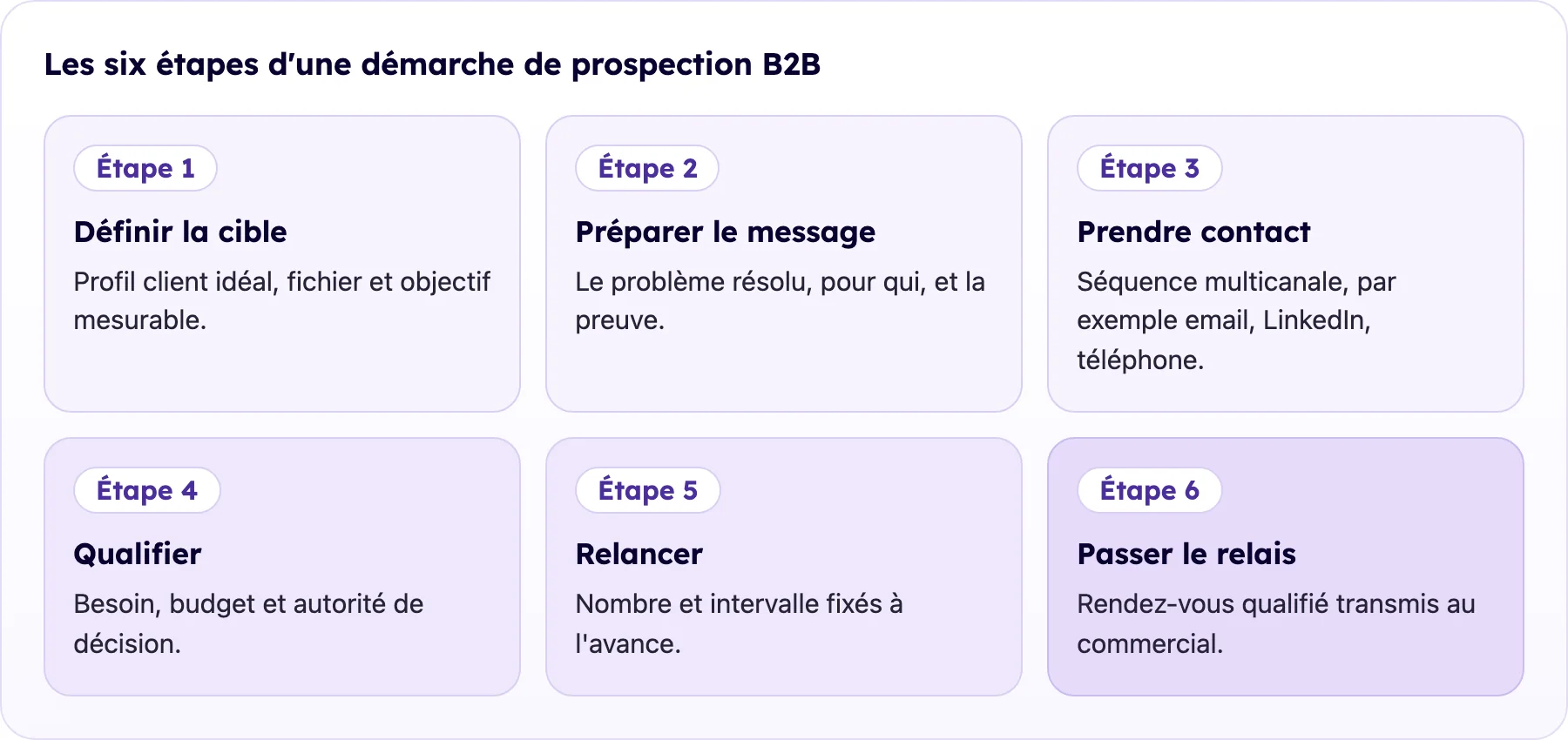
Step 1: Define the target and build the file
It all starts with identifying the targets: industry, company size, geographic area, and the contact’s position. The database is then built as described above. Also set a measurable goal for the campaign—for example, a target number of appointments over a specific period. Without a goal, it’s impossible to know whether the campaign was successful.
Step 2: Prepare the message and the sales pitch
Before making initial contact, prepare what you’re going to say: the problem you’re solving, for whom, and proof that you know how to do it. The first message should start a conversation rather than try to sell. It shows that you understand the prospect’s situation, without resorting to artificial flattery or clichés.
Step 3: Get in touch
Initial contact is made through the chosen channel, often through a sequence that combines several channels over the course of a few weeks—for example, email, LinkedIn, and phone. Each message provides new information, rather than repeating the previous one.
Step 4: Qualify the prospect
Once contact has been established, lead qualification becomes the decisive step. Through open-ended sales questions, this process verifies that the prospect matches your target audience, has a need, a budget, and sufficient decision-making authority. Neglecting this step leads to investing time in prospects who will never sign a deal.
Step 5: Follow up
A prospect who doesn't respond hasn't necessarily said no: they may have been busy, away, or not yet ready. A well-timed follow-up can often get a stalled conversation back on track. Determine in advance how many follow-ups you'll make and the interval between them, then stop at the right time.
Step 6: Schedule the appointment and hand it off
The goal of lead generation is to secure a qualified meeting; closing the deal is the sales team’s responsibility. When a prospect agrees to a meeting, pass on everything you know to the sales representative in charge of the sale: the prospect’s needs, the key contacts, and any objections raised. A poorly handled handoff forces the prospect to repeat everything.
How do you organize a one-month B2B lead generation campaign?
An initial B2B prospecting campaign can be organized over four weeks: one week to prepare the target audience, the contact list, and the messages, followed by three weeks of a multichannel sequence, with a progress review at the end of each week. This timeline is an example created for this article and should be adapted to your sales cycle and the number of accounts you’re targeting.
Week 1: Prepare the target, the file, and the messages
There are no mailings during the first week. This week is dedicated to drafting the ICP and personas, compiling an initial list of accounts, identifying a contact person for each account, and writing the messages for the campaign. Start small—for example, with about 50 accounts: a short, well-chosen list yields better results than a long list sent out too quickly.
This week is also a time to review the framework. Note the source of each contact, draft the notice that will inform people and explain how they can opt out, and create a list of opt-outs to be honored. Finally, verify your email domain. Have your legal counsel review these points before sending the first email.
Weeks 2 through 4: Which multichannel sequence should you follow?
The sequence alternates between channels to maximize visibility without repeating the same message. The table shows an example over a three-week period; the days are counted starting from the first email.
Stop the sequence as soon as the prospect responds—whether positively or negatively—and switch to a one-on-one conversation. A prospect who asks not to be contacted anymore is removed from the list across all channels.
Example of a First B2B Prospecting Email, with Commentary
Here is a draft email based on the fictional ICP scenario described above. Each line serves a specific purpose, indicated in the last column, which provides our editorial guidance.
How should we assess the campaign?
At the end of the fourth week, calculate the conversion rate to the next stage for each stage: valid addresses, responses, qualified responses, and appointments. The stage with the lowest conversion rate is the one that needs to be addressed first. Also review the negative responses: they may indicate what is wrong with the target audience or the message.
B2B Marketing: What CNIL Rules Must Be Followed in France?
When contacting professionals, email or telephone solicitation may be conducted without prior consent, provided three conditions are met: the message relates to their profession, the person has been informed, and they can opt out easily and free of charge. When contacting individuals, prior consent is required. Have your legal counsel review these rules before launching a campaign.
Email Marketing: Providing Information and Allowing Opt-Out
Regarding email marketing, the CNIL states that individuals must give their prior consent if they are private citizens, or have the right to opt out if they are business professionals (CNIL, Email Marketing). When targeting a business, marketing may be based on legitimate interest “when the purpose of the solicitation is related to the profession of the person being contacted.” The rules that must be followed include informing the individual and providing a simple, free opt-out option.
The same fact sheet includes three practical points:
- Each request must make it possible to identify the organization that sent it, and to simply reject subsequent messages;
- Individuals may request access to their data, and the organization must respond within one month at the latest, barring exceptions;
- Generic email addresses for a company—such as contact@ or info@—that refer to legal entities are not subject to the principles of information and objection outlined in this fact sheet.
Purchased or Enhanced File: What Precautions Should You Take?
If the data was obtained from a third party, the CNIL requires that you ensure the individual has been informed of the possible use of their contact information for marketing purposes and is able to opt out (same record). Based on our interpretation, this verification is your responsibility even if the data comes from a supplier or a data enrichment tool. Our advice: Ask the supplier how the information was collected, and keep a record of their response.
The CNIL also devotes a page to the use of an opt-out list to comply with requests to opt out of marketing. Our advice: Keep a list of people who have opted out, and compare it to each new database before sending out any mailings.
Telemarketing: What Are the Rules for Professionals?
According to the CNIL, the rules governing telemarketing have changed since August 11, 2026. Based on our reading of the fact sheet, the change applies to individuals: to contact them for marketing purposes, you must first obtain their consent. Businesses, on the other hand, have the right to opt out, and they must be provided with relevant information. The same guidance document specifies that telemarketing to businesses may be based on the organization’s legitimate interest when the call is related to their profession. The CNIL has announced that this guidance document will be supplemented by a list of frequently asked questions: be sure to review it before launching a call campaign.
What tools should you use for B2B sales prospecting?
B2B lead generation tools can be grouped into four categories. A CRM system keeps a record of interactions; sales intelligence and data enrichment tools identify leads; an engagement platform sends out sequences; and LinkedIn is used for targeting and reaching out. These tools eliminate repetitive tasks; they do not replace the process.
What are the four categories of prospecting tools?
- A CRM, such as HubSpot or Pipedrive, centralizes accounts, contacts, and communication history; it serves as the memory of your prospecting efforts;
- Sales intelligence anddataenrichment tools identify companies and populate contact information;
- Salesengagement platforms, such as Lemlist, send email sequences and track responses;
- LinkedIn and Sales Navigator are used for targeting and reaching out to contacts on the network.
First, choose the process; then choose the tool. A tool purchased before defining the target and the sequence automates a process that doesn't work yet.
How can we automate lead generation without making it impersonal?
Automation frees up time spent on administrative tasks: data entry, scheduled mailings, and follow-up reminders. This time can then be devoted to engaging with others, listening to them, and tailoring your message to each individual.
If used incorrectly, it standardizes messages to the point of stripping them of any personal touch. A prospect who perceives a message as generic—even if it’s well-written—is less likely to respond. Make sure to keep a human touch at the moments that matter: choosing which accounts to target, the first sentence of the message, and the response to an interested prospect.
What Can AI Do for B2B Lead Generation?
Artificial intelligence helps prepare for prospecting: summarizing a company’s business based on its website, identifying signals in news articles, and suggesting a draft message based on your ICP. For example, an assistant like ChatGPT can list industries similar to those of your best customers, which you can then verify in the Sirene database.
Two precautions are necessary. AI does not verify the data it generates: any name, job title, or address suggested by AI should be checked before being sent. And a contact list is still a list of personal data: do not entrust it to an external tool without knowing what it does with it.
What metrics should you track to measure your lead generation efforts?
To evaluate a B2B lead generation campaign, track one metric at a time. Measure the percentage of valid addresses in the list, the response rate to initial contact, the percentage of qualified responses, and then the appointment conversion rate. Include the outcome of those appointments in terms of sales, which reflects the quality of the qualification. The number of emails sent, on its own, says nothing about quality.
Don’t set a threshold based on another industry; instead, compare your numbers from one campaign to the next, assuming the same target audience. Also note the reason for each lost opportunity: budget, timing, competition, or lack of need. After a few months, these reasons will reveal what needs to be adjusted in the target audience or the messaging.
What mistakes cause a sales outreach effort to fail?
Five common mistakes can derail a prospecting effort: prospecting without a written target, talking about yourself in the first message, giving up after a lack of response, focusing on volume rather than appointments, and ignoring the rules and deliverability. These mistakes stem from how the process is organized, and each can be corrected with a simple rule.
Mistake 1: Prospecting without a written target audience
Targeting “all small and medium-sized businesses” is like talking to no one at all. Define your ICP and personas before purchasing a database or a tool.
Mistake 2: Talking about yourself in your first message
An initial message that simply introduces the company, its history, and its products gives the prospect little reason to respond. Start by addressing the prospect's problem, and only then discuss what you have to offer.
Mistake 3: Giving up after a silence
Silence doesn't mean a "no." Plan to follow up from the start, using a different angle each time.
Mistake 4: Focusing on volume rather than appointments
Sending a lot of messages makes it look like you're working. What matters are the qualified appointments and what comes of them.
Mistake 5: Ignoring the Rules and Deliverability
A file of unknown origin, an unauthenticated domain, or the lack of an opt-out option can derail an entire campaign. Check these points before sending your first email.
Conclusion: What Is B2B Prospecting, and How Do You Do It?
B2B sales prospecting is the organized search for new business clients, leading up to a qualified meeting. It is carried out as a process: a written target, a verified list, multiple channels, sequential steps, and tracked metrics. In our view, the selection of recipients matters more than the number of messages sent.
Three criteria guide the launch of a campaign: a specific target audience, channels tailored to your decision-makers, and a consistent pace over time. When targeting professionals, each communication must be relevant to their profession, provide the recipient with information, and offer a simple way to opt out.
At Scal-IA, we start with the target audience and the message, and then our agency handles the strategy, the technical aspects, and ongoing optimization.
Frequently Asked Questions About B2B Sales Prospecting
What is sales prospecting?
Sales prospecting is the active search for new customers. It involves identifying companies or individuals who are likely to make a purchase, contacting them, and verifying that they have a genuine need, with the goal of securing a meeting. In B2B, it targets companies and hands off to the sales team once a meeting has been secured.
What is the best method for B2B lead generation?
There is no single method that works best in all circumstances. We recommend combining a written outreach message, two or three channels tailored to the target decision-makers, and a follow-up sequence that is sustained over time. To get started, test this sequence on a short list of selected accounts, then adjust the target audience and message based on the responses.
What is the difference between prospecting and cold calling?
In common usage, “cold calling” refers to unsolicited contact with a potential customer—by phone, in writing, or in person. The term also has a legal meaning, particularly as it relates to consumers. Cold calling is only one part of the sales prospecting process: this process begins earlier, with the selection of the target audience and the creation of a prospect list, and continues after the initial contact, through lead qualification and follow-up.
What is the difference between prospecting and selling?
Lead generation identifies and qualifies potential customers up to the point of scheduling a meeting. The sales team then takes over: conducting a detailed needs assessment, presenting a proposal, negotiating, and closing the deal. Both processes require different skills, and a company may assign them to different people.
How do you find B2B clients when you're just starting out?
Start with your first customers or your network to define your target audience; if that’s not possible, formulate a target hypothesis and test it on a few dozen accounts. Next, compile a short list of companies from the Sirene database, then identify the relevant contact person and their business contact information for each one, in compliance with CNIL regulations. Contact them by email and phone with a message focused on their specific issue.
How do you find clients on LinkedIn?
Target decision-makers by job title, industry, and company size using LinkedIn Search or Sales Navigator, LinkedIn’s paid service. Start the conversation with a personalized message that addresses their specific situation, then follow up via email or phone once the prospect responds. Send invitations and messages yourself: LinkedIn’s terms of service prohibit unauthorized automated methods.
How do you reach out to business clients via email?
Write to the person your offer is intended for, using a clear subject line and a brief message that addresses their issue. When emailing a professional, the email must pertain to their profession; the recipient must be informed of this and have the option to opt out easily and free of charge; each message should state who you are. Check your sender domain before launching the campaign.
Can you reach out to a professional via email without their consent?
Yes, under certain conditions. According to the CNIL, when contacting a professional, prior consent is not required if the message relates to their profession, if the person has been informed, and if they can opt out easily and free of charge. For individuals, prior consent is required.
How can you expand a prospect database?
Start with the list of companies, then add the decision-maker, their job title, and their business contact information using the company’s website and data enrichment tools. Verify each email address before sending, note the source of each piece of data, and ensure that the individuals have been informed and can opt out of marketing communications.
What is a prospecting file?
A prospecting file is a list of companies and individuals that a sales team plans to contact, including relevant information for each one: industry, size, contact person, contact information, data source, and contact history. It is built based on an ideal customer profile and is continuously updated.
What does Scal-IA offer in terms of B2B lead generation?
The Scal-IA agency is implementing an automated and personalized B2B lead generation strategy: intent detection, targeting based on the ICP and enriched data, and multichannel sequences on LinkedIn and via email, all integrated with the CRM.